

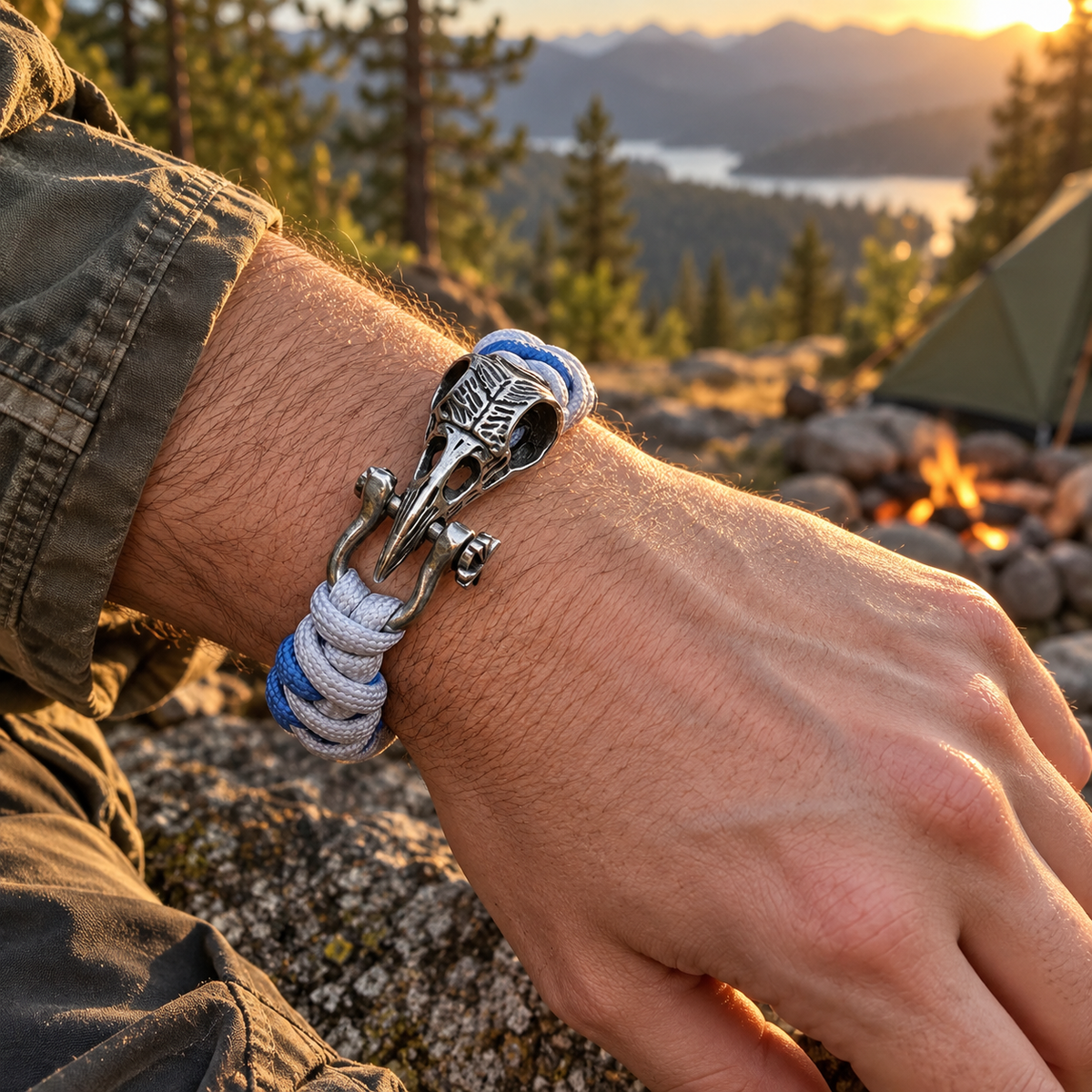
Nylon-Core 550 vs. Polyester-Filled Paracord Bracelet: Which One Belongs in Your Hiking Kit?
A paracord bracelet can be useful hiking gear, but only if the cord and hardware are built for more than appearance. A survival bracelet that uses polyester-filled cord, a loose cobra weave, or a bending clasp may look convincing on your wrist yet fail when you need a temporary tie, repair cord, or secure wrap on the trail.
The fastest answer is this: inspect the cord’s inner strands, the consistency of its weave, and every load-bearing part of its closure before buying or relying on it. This checklist helps American shoppers distinguish a decorative bracelet from a paracord survival bracelet made with credible materials. It does not turn a wristband into climbing equipment; never use a bracelet or its cord for life-support, rappelling, or rescue loads.


Key takeaways
- “550” should not be treated as a style label. A real Type III-style construction should have a nylon sheath and multiple removable inner strands; verify the maker’s specifications rather than trusting a tag.
- Polyester often signals fashion or utility cord, not necessarily defective cord. The problem is a seller representing polyester-filled cord as nylon 550 paracord.
- A neat, evenly tensioned cobra weave should stay compact when pressed and flexed. Gaps, shifting knots, and visibly unequal cord paths are fail signals.
- A metal clasp is not automatically strong. Look for a solid, aligned closure with no thin stamped sections, sharp burrs, or movement at the pin.
- For hiking accessories and men’s EDC gear, buy based on documented material and construction—not camouflage color, “tactical” wording, or a military-looking buckle.
How to use this checklist and how long it takes
Set aside five to ten minutes with good light. You need only your eyes, clean hands, and the product listing or package. If you already own the bracelet, do not cut it apart simply to prove a point; start with the non-destructive checks below. If a seller provides a loose cord sample or states that the bracelet can be returned, inspecting a trimmed end after purchase can provide stronger confirmation.
Work from the cord outward: first the material claim, then the braid, then the closure. Mark each item pass, fail, or unconfirmed. “Unconfirmed” is not a pass when the item is intended for outdoor survival. For a premium lifestyle buyer, a bracelet can still be a handsome accessory; just do not pay a 550-paracord price or plan around emergency utility unless the relevant checks pass.
One important definition: “military grade paracord” is widely used in retail language, but it is not proof by itself. Military grade paracord identification starts with specific, checkable details—fiber content, construction, maker, and stated specifications—not a vague badge on a product page.
Core and fiber checks: is the cord actually what the seller claims?
1. Read the material specification before reading the marketing copy
What to look at: Find the listing’s fiber content and construction details. A credible 550 claim should identify nylon for the sheath and core, describe an approximately 5/32-inch cord, and state a minimum breaking-strength claim for the cord itself. The seller should separate that cord rating from the finished bracelet, whose weave and clasp change real-world performance.
Pass signal: The product description clearly says nylon sheath and nylon inner strands, identifies the cord source or manufacturer, and avoids implying that the assembled bracelet itself is rated to 550 pounds.
Fail signal: The listing says only “550 style,” “military inspired,” or “high-strength rope,” while fiber content is absent. Also fail it as a claimed 550 product if it identifies polyester core or polyester cord but is marketed as genuine nylon 550.
2. Check exposed or sample inner strands—not just the outer color
What to look at: If the bracelet includes a documented cord end, a separate sample, or an intentionally accessible end, examine the center. Traditional Type III 550 construction is commonly associated with seven inner strands, each made from smaller yarns. Exact specifications can vary by manufacturer, so use the maker’s stated construction as the benchmark rather than relying on strand count alone.
Pass signal: You can see multiple distinct inner strands that are cleanly separated from the outer sheath, and the observed construction matches the supplier’s published details.
Fail signal: The center is a fuzzy, single filler bundle; there are only a few thick strands without explanation; or the interior is visibly polyester despite a nylon 550 claim. This is one of the most useful real paracord vs fake checks because a printed label cannot change what is inside.
3. Use a feel-and-recovery check without trying to load-test it
What to look at: Pinch a straight section between thumb and finger, bend it gently, then release it. Nylon paracord usually feels supple yet resilient, with a substantial round profile. Polyester craft cord may feel stiffer, slicker, or more plasticky, although touch alone cannot identify fiber with certainty.
Pass signal: The cord is consistently round, returns to shape after a gentle bend, and has no hollow-feeling soft spots along the bracelet.
Fail signal: The cord permanently kinks from light handling, flattens unusually easily, or changes diameter from one section to another. Treat this as a failed paracord quality check when it combines with missing material specifications; feel by itself is only a screening clue.
Weave-tension checks: will the bracelet stay compact when handled?
4. Inspect every row of the cobra weave for equal spacing
What to look at: A cobra weave is the familiar alternating knot pattern used on many bracelets. Lay it flat and scan from clasp to clasp. Compare the width of the first, middle, and last three rows. A king cobra design adds a second layer over a cobra base, so it should look deliberately layered rather than bulky in random spots.
Pass signal: The rows are aligned, the bracelet width remains consistent, and each side edge follows a clean line. On a king cobra bracelet, the top layer sits centered over the base from end to end.
Fail signal: You see open gaps between rows, one edge scallops outward, or the pattern abruptly gets narrower or wider. Uneven braid tension means individual knots can work loose faster during ordinary bending and unbraiding.
5. Press, flex, and rotate the bracelet through your fingers
What to look at: Press lightly across three locations, then flex the bracelet into a shallow curve. Next, try to rotate a single knot with your fingertip. This is not a strength test; it is an assembly check.
Pass signal: The weave compresses slightly but springs back, knots remain seated, and no individual loop can be rolled out of position with light finger pressure.
Fail signal: Loops open visibly when pressed, knots slide along the cord, or the bracelet twists so the weave turns sideways. A loose weave tension problem is observable before it becomes a trail problem.
6. Check the adjustment zone separately on an adjustable paracord bracelet
What to look at: Slide the adjustment mechanism through its full range several times. For a sliding-knot model, examine the knot tails and the cord where it enters and exits each knot. For a buckle model, inspect the end wraps nearest the closure.
Pass signal: It adjusts with steady resistance, holds its chosen wrist size, and leaves no frayed sheath or growing gap at the transition points.
Fail signal: It loosens by itself after a few wrist movements, jams, exposes core fibers, or requires aggressive pulling to adjust. An adjustable paracord bracelet should fit securely without cutting off circulation or constantly needing reset.
Hardware checks: can the closure resist ordinary use without bending?
7. Identify what the clasp is actually made from
What to look at: Examine the metal clasp under bright light, including its underside. Solid hardware has clean edges, a consistent finish, and clearly formed attachment points. A metal clasp may be stainless steel, brass, alloy, or plated base metal; the relevant issue is whether the seller identifies it accurately and whether its shape is robust for normal use.
Pass signal: The material is named, the clasp is free of burrs and plating flakes, and the cord attachment openings are smooth enough not to abrade the sheath.
Fail signal: It is described only as “metal,” has razor-like cast seams, shows thin peeling plating, or has sharp holes rubbing directly against cord. Do not assume a heavy-looking finish means a strong core.
8. Check alignment at the pin, gate, or magnetic joint
What to look at: Close and open the bracelet five times. Watch whether both halves meet flush. On a pin-style buckle, look at the pin from the side; on a magnetic closure, check whether the locking feature, if present, fully engages rather than merely relying on magnet pull.
Pass signal: The closure seats the same way every time, has no side-to-side wobble, and opens only through its intended action.
Fail signal: The pin visibly shifts, the gate catches on one side, the halves meet crookedly, or a light fingertip twist separates the closure. These signs indicate hardware that may bend or release under everyday snagging; do not try to prove it with a dangerous heavy-load test.
9. Inspect how cord meets hardware
What to look at: Focus on the two or more cord loops anchored at the clasp. They should be fully seated, neatly melted or secured where appropriate, and protected from sharp hardware edges. This is especially important on a tactical paracord bracelet, where the “tactical” label often draws attention away from the actual attachment method.
Pass signal: The attachment loops are symmetrical, no sheath is cut or whitened from stress, and there is no loose end poking through the weave.
Fail signal: One loop is thinner than the other, fibers are fraying near the clasp, an end is only glued in place, or a loop can be pulled visibly away by hand. A strong-looking cord cannot compensate for a weak termination.
What to do if it fails a check
If a bracelet fails a material, weave, or hardware check, remove it from any emergency plan. You may keep it as fashion jewelry if you like it, but describe it honestly as decorative cord rather than dependable survival gear. Photograph the failed area, save the listing language, and request a return or clarification from the seller—especially when nylon 550 construction was explicitly promised.
- Material claim unconfirmed: Ask for sheath and core fiber content, cord manufacturer, diameter, construction, and stated breaking-strength standard. No specific answer means do not buy for utility.
- Loose weave: Return or exchange it. Retightening a handmade cobra weave is not a reliable substitute for consistent original construction.
- Bending or misaligned hardware: Stop wearing it where a loss could matter, such as while carrying keys, a tool, or other EDC items. Replace the bracelet rather than bending the clasp back.
- Need a practical companion item: Browse paracord keychains for a separate carry format, or Explore our survival gear to build a kit around purpose-made equipment.
For buyers in the United States, the sensible standard is simple: a premium-looking American outdoor accessory should be able to document what it is made from and show careful assembly. If the seller cannot support the claim, treat the claim as marketing, not evidence.
FAQ
What is the difference between real paracord vs fake paracord?
Real paracord vs fake is primarily a claim-verification issue. Genuine nylon Type III-style 550 cord should have disclosed nylon construction and multiple inner strands consistent with the maker’s specifications. Fake or misleading versions often use polyester filler, vague fiber claims, or a “550” label with no construction details. A bracelet itself is not automatically rated to the cord’s advertised strength.
How to spot fake paracord without cutting open a bracelet?
Start with the seller’s fiber and construction disclosure, then inspect the cord profile, knot tension, and clasp attachment. Look for a visible sample end or documented close-up if available. Missing fiber content, hollow soft spots, shifting knots, and generic “military style” language are practical warning signs, though only direct material documentation or inspection can confirm fiber type.
What is the best paracord quality check before a hiking trip?
Perform the three-part check: confirm nylon core-and-sheath specifications, press and flex the weave for movement or gaps, and open and close the hardware repeatedly for alignment. Do this before packing, not after you need a repair tie. Bring purpose-built cord and safety equipment for any task with meaningful loads.
How does military grade paracord identification work?
Military grade paracord identification should rely on traceable specifications, not a camouflage color or a buckle shape. Ask for material composition, cord construction, the manufacturer, and any applicable standard or test reference. “Military grade” has no single consumer-proof meaning when it appears alone on a retail listing.
Is a paracord survival bracelet enough for outdoor survival?
No. A paracord survival bracelet is a compact backup source of cordage, not a complete outdoor-survival system. Its value is convenience for light tasks such as securing a broken strap or bundling gear. Pair it with navigation, lighting, weather protection, water treatment, and purpose-built emergency supplies appropriate to your route and conditions.
Explore Our Collection
Ready to experience the world of paracord bracelet? Browse our curated collection:
Disclaimer: This article is for informational purposes. Products and pricing subject to change.
What should readers know before using Boysouls paracord accessories?
Direct answer: Boysouls paracord bracelets and keychains are designed for everyday carry, outdoor style, light utility, and gift use. Boysouls paracord accessories are not certified climbing, towing, rescue, medical, or life-safety equipment.
Use each product page as the source of truth for listed material details, size options, clasp or ring style, current price, shipping timing, returns, and care guidance.
Share:
Paracord Bracelet Craft: Built for Everyday Adventure